/home/me/reviews/beyond_all_reason.txt | grep "verdict: ehh"
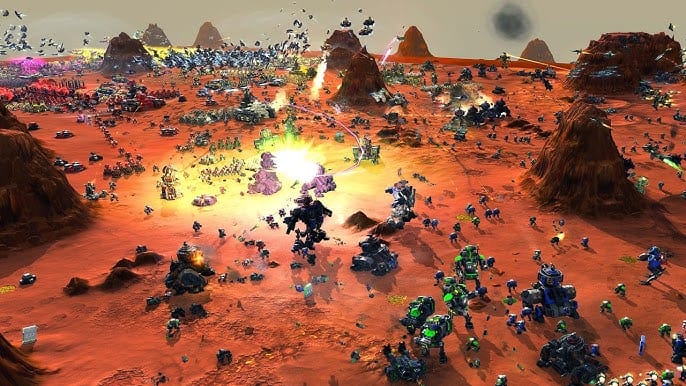
when i first heard about beyond all reason (bar), i assumed it was just another indie attempt to revive the real-time strategy genre. i was wrong. this isn’t a nostalgia project. it’s a full-scale, modern rts with thousands of units, advanced pathfinding, physics-based combat, and visuals that rival commercial titles. and it’s open-source.
this post breaks down what playing beyond all reason feels like from a newcomer’s perspective: the setup, the first game experience, what the learning curve is like, and why it might be the most impressive open-source rts ever made.
setting up: fast, clean, and community-driven
the installation process is straightforward. i downloaded the client directly from beyondallreason.info. the launcher handles updates automatically, detects system specs, and lets you join multiplayer or start a solo skirmish. from the start, it’s clear this isn’t a hacked-together fan remake. the ui is clean, scalable, and optimized for modern hardware. there’s a built-in lobby with chat, live replays, and active community servers. it feels like steam integration, minus the corporate layer.
first impressions: scale that blows you away
i loaded a 1v1 skirmish on a medium map, expecting something manageable. within ten minutes, i was commanding dozens of construction bots, tanks, and aircraft. the scale escalates quickly. bar inherits its roots from the spring rts engine, but pushes it further with better pathfinding and modern shaders. you can zoom from a macro view showing the entire battlefield down to micro-controlling a single unit firing missiles in real-time. the terrain deformation, explosions, and physics interactions make battles feel alive. unlike traditional rts titles where units awkwardly clump and glitch, bar handles hundreds smoothly. the sense of chaos is controlled, not cluttered.
the gameplay loop: economy, expansion, and efficiency
every match starts with an arm commander, your core builder unit. from there, you construct energy generators, metal extractors, and factories. it’s not just “gather and spend” like age of empires—it’s a continuous flow economy. you produce metal and energy per second, and units consume resources continuously while being built. that changes how you think about management. it’s not about stockpiling; it’s about balancing income and output. if your production outpaces your economy, your whole system stalls. if you overbuild power plants, you waste potential offense. efficiency is everything. as i learned, building queues and scaling production are the core challenges. the best players automate dozens of factories while managing expansions across multiple fronts.
combat: physics over scripted battles
combat in beyond all reason feels physical rather than mathematical. projectiles have travel time. missiles can be intercepted. line of sight and terrain actually matter. you can hide units behind cliffs or ambush from forests. watching a formation of tanks crest a hill while aircraft dogfight overhead feels cinematic—but it’s all running on open code. the first time i built a nuclear silo and watched the missile arc across the map, impact, and deform the ground,
i realized this wasn’t just “good for open-source.” it’s objectively good.
the learning curve: steep but rewarding
bar doesn’t spoon-feed you. there’s no campaign to hold your hand. the tutorial is minimal, and you’ll probably lose your first few matches just trying to understand production flow.but once it clicks, the loop becomes addictive. the community discord and wiki are packed with guides, replays, and coaching resources. once you grasp hotkeys, queue logic, and map control, you start feeling like an actual field commander rather than a micromanaging clerk.
what makes it special
- massive scale without lagyou can have thousands of units on modern hardware and it still runs smoothly.
- deep modding and open sourcethe game’s entire engine, assets, and logic are open. players constantly release new units, maps, and balance tweaks.
- active communitythere are always multiplayer matches running, and the devs are active in discord and github.
- visual fidelitythe combination of dynamic lighting, realistic terrain, and huge explosions makes it visually competitive with mid-tier commercial games.
tips for first-time players
- start with 1v1 vs easy ai on a small map to learn pacing.
- build at least two metal extractors and three energy plants early.
- keep your construction bots active at all times—idle bots are wasted potential.
- don’t overbuild units early; ensure your economy can sustain continuous production.
- watch replays of good players to understand expansion timing and map control.
final thoughts
i thought it was pretty interesting but ultimately, i don’t know if it has the lore like starcraft to keep me hooked. i would probably play it more with friends, if i had any that played this.